
local_fire_department
The Warm-Up Myth
Science says everything you believe about warm-ups is probably incorrect 🙈
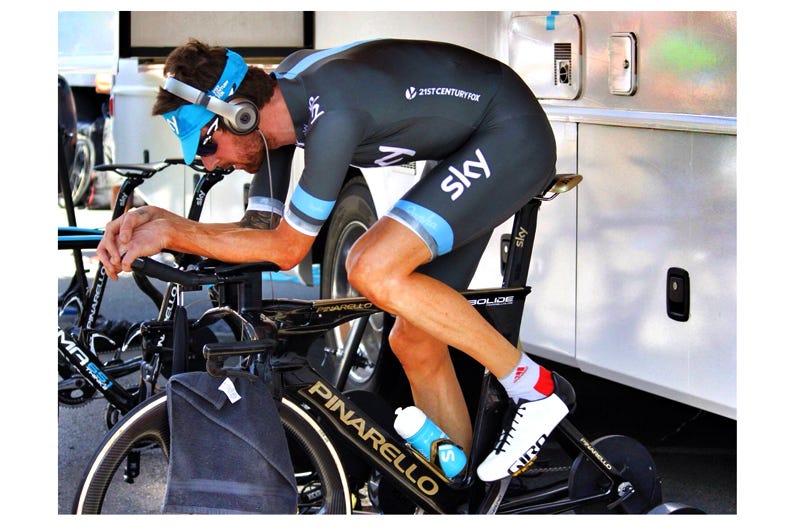
Why do cyclists love warm-ups so much?
Well let’s start with some non-specific claims about physiology…. Warm-ups are thought to help by raising core and muscle temperature. A single-degree increase *is associated* with higher peak power and performance by two to five percent. BUT this could just be a normal effect of exercising from a cold start. In fact, high temps equally cause a deterioration in performance: a heightened core temperature is a primary cause of fatigue. Warm-ups might cause improved VO2 response at the start of the race which has been called post-activation potentiation (or PAP). But in most studies, the enhanced VO2 response only lasted a few minutes longer than it did in athletes who didn’t warm up at all.
That’s vague! I am not convinced! But I am sure it helps psychologically; and I am sure it helps with pre-race nervous energy; and it likely helps focus repetitive behaviours but in truth, the main reason is likely tradition. Everyone thinks it helps performance but no one quite knows how…

Yes, almost everyone thinks warm-ups are a good idea and not just any warm-ups: hard warm-ups, long warm-ups; heck hard long warm-ups! Because if they are a good idea, people think more must be better. But this attitude “you cannot get enough of a good thing” is usually wrong. Think about it.
A little coffee = good ↔️ too much = bad
A little HIIT training = good ↔️ too much = bad
A little weight loss = good ↔️ too much = bad
A little rest = good ↔️ too much = bad
And the same applies to warm-ups. There is a good case for *some* warm-up before a competitive event but more is not better, it is definitely worse. And after 20 years of excessive warm-ups, we finally have the data to prove it.
help_outline
Questioning the Traditional Warm-up
The first good evidence that “traditional warm-ups” were less than ideal appeared in 2005. Here is the paper from linkHajaglou who studied 8 well-trained road cyclists, doing 3-km time trials, randomly assigned to no warm-up (NWU) vs easy warm-up (EWU) (15 min) vs hard warm-up (HWU) (15 min hard).
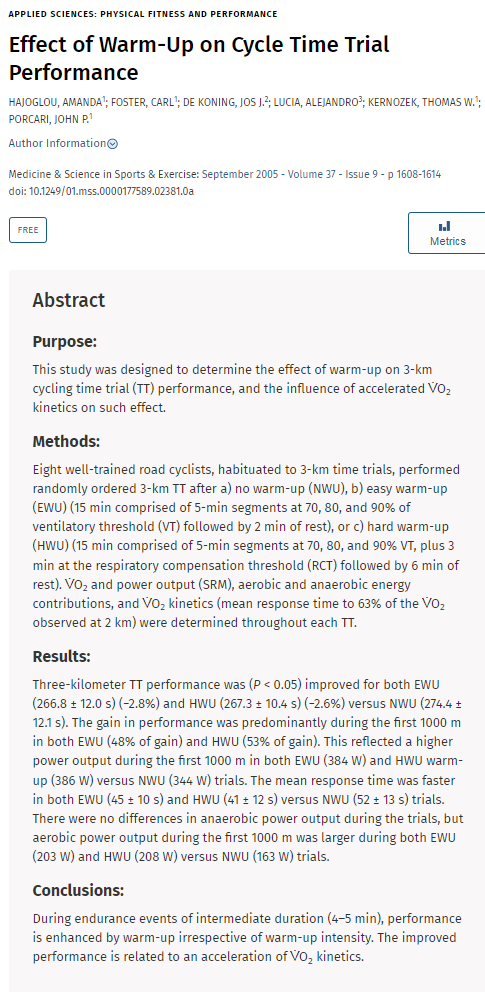
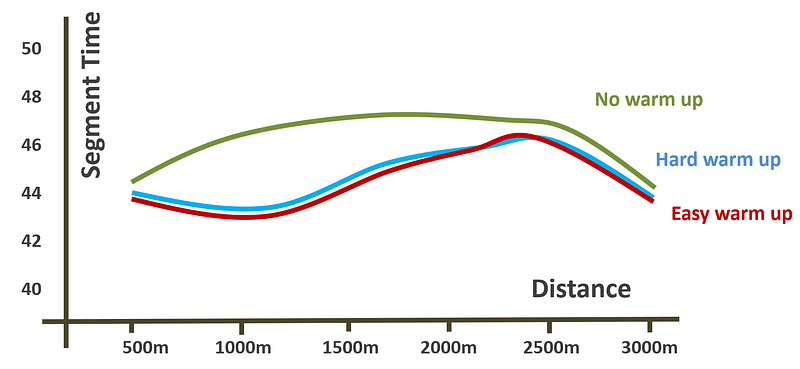
What they found was that the gain in performance was only in the first 1000m (3 mins) in both EWU (48% of gain) and HWU (53% of gain). There were no differences in anaerobic power output during the trials. By the 3000m the benefits were no longer there. Let me repeat, results favoured some warm-ups only for the first 3 mins of the event. AND hard warm-ups were no better than easy ones.
timer
Evidence for Warming Up Before Short Events
In a link2011 study, Tomaras & MacIntosh published research in the Journal of Applied Physiology brilliantly called “Less is More” comparing a 45-minute traditional track warm-up (riders ramped up to 95 percent of max heart rate followed by four sprints) to a 15-minute warm-up in which riders ramped up to only 70 percent and did one sprint. Less was better, the shorter warm-up caused less fatigue and hence higher peak power. Experimental WU (peak power output = 1,390 ± 80 W, work = 29.1 ± 1.2 kJ) vs traditional WU (peak power output = 1,303 ± 89 W, work = 27.7 ± 1.2 kJ).
This finding was replicated in two link2015 studies of the complex warm-up routine of elite Danish athletes vs a 15-minute moderate spin. 12 highly trained male cyclists performed 3 warm-up strategies lasting 20 min before a 4-min maximal-performance test (PT). Strategies consisted of moderate-intensity exercise (50% iPPO) followed by 6 min of recovery (MOD6) or progressive high-intensity exercise (10–100% iPPO and 2 × 20-s sprints) followed by recovery for 6 min (HI6) or 20 min (HI20). They found that the elite routine reduced performance in a four-minute time trial.
The second link2015 study led by Dr. Jordan McIntyre at the Auckland University of Technology Performance Institute found no benefits from VO2 priming in a 3km time trial. In fact, the group with the hardest warm-up (five, 10-second near maximal sprints) had the best VO2 response — but the worst performance.
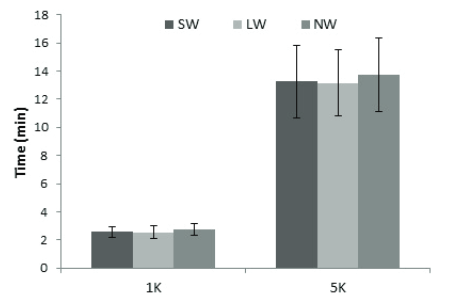
A link2017 study by Bunn provided even more info after three different warm-up conditions on a 5K cycling time trial (TT); namely a short warm-up of three minutes at 60% VO2max (SW), long warm-up of ten minutes at 60% VO2 max (LW), or no warm-up (NW). Warm-up length was not impactful on 5K TT performance and only had a small benefit in the first 1k.
route
Evidence for Warming Up Before Longer TT Events
The evidence supporting anything but short, easy warm-ups is similar for longer events.
A link2020 RCT study from Gil involving 15 male cyclists performed a 20-minute cycling time trial (TT) preceded by no warm-up, a standard warm-up (10 min at 60% of VO2peak), or a hard warm-up with sprints. No warm-up benefits were found for overall TT performance or for perceptual or physiological responses during the TT.
As it happens, a linknew study from David Barranco-Gil at the University of Madrid compared two warm-up protocols before a 20-minute cycling time trial: 10 minutes @ 60% VO2 max or 5 minutes @ 60% VO2 max + 3x 10s sprints. Again, there was no difference in cycling performance between the two warm-ups.
In 2020, Vangsoe (linkcitation) randomized 12 well-trained cyclists to perform 4 different warm-up strategies prior to completing a maximal-effort 1-km TT. Performance time and power, quadriceps electromyograms, muscle oxygen saturation (SmO2), and blood lactate were measured to determine differences between trials. There were no significant differences (P > .05) in 1-km performance time, power output, muscle electromyogram activity, SmO2, or recovery blood lactate concentration between conditions.
pool
What About Warm-Ups in Running and Triathlon?
I look at this evidence linkhere. It’s basically the same story, if you don’t have time to look.
rule
Conclusion: Warm-Up Rules of Thumb
Warm-ups can help but all the evidence suggests short easy warm-ups are better. Of course, you are welcome to do whatever you find most helpful. A funny thing about exercise science: “rider’s preference” often beats other options, because once a rider has built a habit, they don’t want to change. We easily become prisoners to tradition. Time and again athletes rejected aero bikes, aero wheels, aero jerseys, long-sleeve jerseys, and aero helmets because they wanted their old comfortable kit or they wanted a weight saving even on a flat TT. And it’s true the science might say do ‘X’, but if that drains your motivation, then there will be a problem. So if you like your long warm-up, that’s fine, but I am saying that the evidence isn’t with you… and maybe it is worth rethinking your habits?
Here is my takeaway:
- Longer harder warm-ups immediately use the metabolic fuel in the blood and muscle you need for the actual event.
- Warm-ups are mostly for psychological preparedness, so stop when you are ready to start.
- Do less in longer races, and in endurance races… just start slow.
- Don’t cool down too much between a warm-up and event.
- Don’t warm up to the point of fatigue.
- Don’t feel obliged to follow someone else’s warm-up.
pedal_bike
But wait… about those pros!
“OK, fine, you make a good case, but you didn’t explain Wiggins’ 30mins warm up?”. You are not Wiggins, and Pros have roughly 10x the time-to-exhaustion as you (at threshold)… so I would say his 30mins warm-up would be roughly the same as a 3min warm-up for you. They have much greater aerobic reserves, so a 10-20m warm-up is relatively tiny for them.